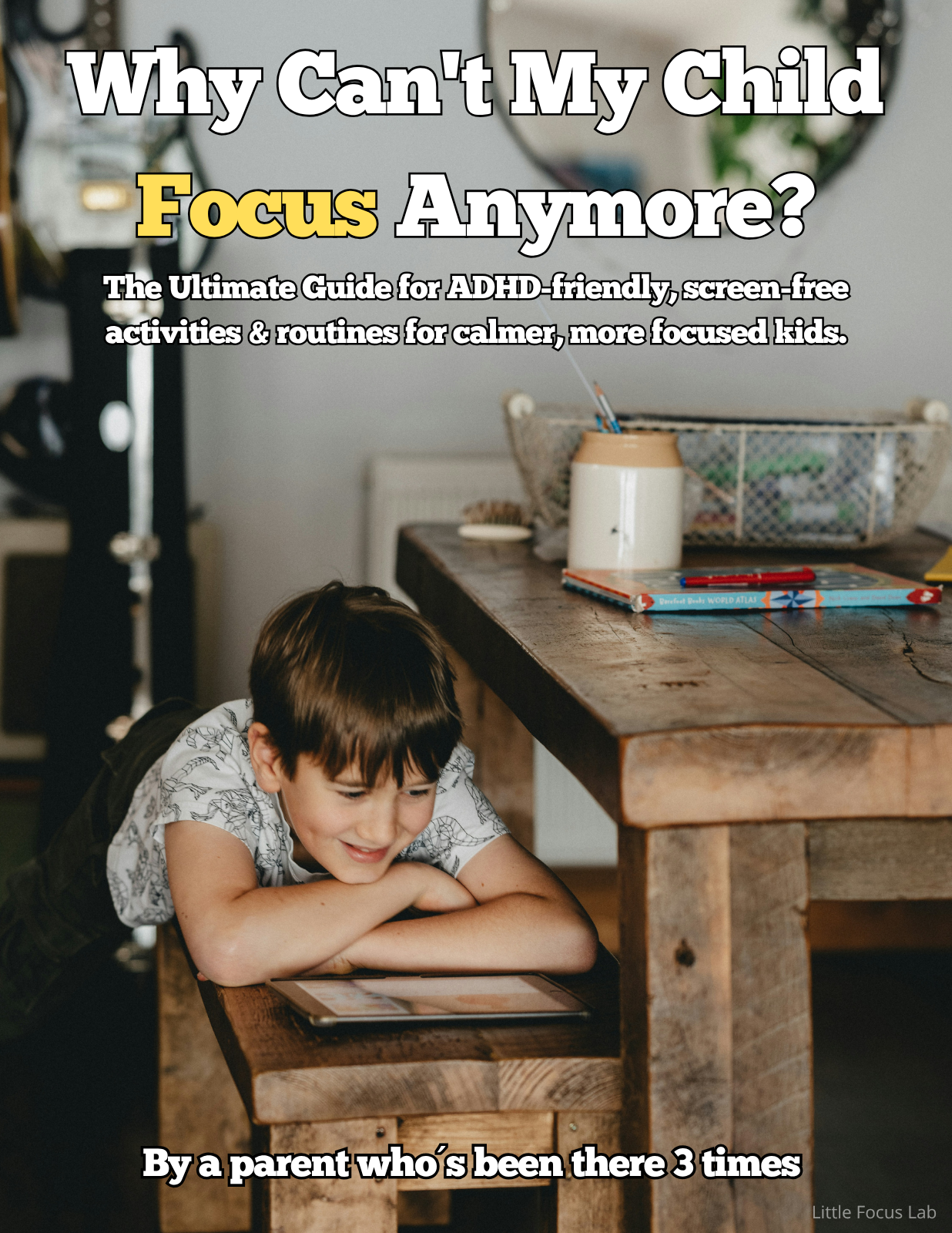
Why Can't My Child Focus Anymore?
It used to take one reminder. Now it takes five, homework still ends in tears, and a screen is the only thing that holds them. You keep wondering if it's just a phase or something to handle differently at home. This is a calm, practical guide for exactly that.

Sound familiar
If your child checks out before the work even starts, you're not imagining it
One worksheet takes an hour, three snack breaks, and at least one meltdown.
You ask them to start. You ask again. You're still asking twenty minutes later.
Real play looks boring to them now. A screen never does.
They lose the thread mid-task, mid-game, mid-sentence.
You keep wondering if this is a phase or something you should be fixing now.
None of this means you've done something wrong. It usually means the day has more noise in it than one kid can sort out alone.
The 4 to 6pm stretch
Homework was supposed to take twenty minutes. It's been an hour and nobody's winning.
This guide is for the version of that evening where you have a plan instead of a standoff.
Why it's harder than it was for you
Your child isn't broken. The day got loud.
Focus rebuilds in the boring, unstructured stretches, and those mostly disappeared. Apps grab a kid the second something gets dull, so the quiet where attention resets never arrives. "Won't focus" is usually a kid with nowhere to come down.
You don't fix that with a stricter chart or a bigger consequence. You fix it with a few calmer edges on the day and something to reach for that isn't a screen. That's what this guide gives you, ready to use tonight.
What you'll actually be able to do
Practical help you can use the same afternoon
No theory to study and no system to live up to. Concrete moves for the parts of the day that are actually hard.
Get a small win before bedtime
Five things you can try tonight without rearranging your life. Pick one, see if it helps, keep what works.
Give the after-school hours a shape
A landing routine that lets a wound-up kid come down first, so homework isn't a fight you have every single day.
Have something other than the tablet
40 screen-free activities sorted by how long they actually hold a kid, each one tagged with an age.
Know what to say in the hard moment
Plain words for the meltdown, the screen going off, and the morning that's already a mess, so you're not finding them mid-storm.
What's in the PDF
Everything you need for calmer afternoons, in one guide
Read it tonight. Use what fits your kid for months.
Plus a 24-hour reset, breathing exercises kids actually like, and the exact words for the hard moments.
A real look inside
This is what you're actually buying
Not stock screenshots or rewritten blurbs. These are real pages from the guide, in the layout you'll be reading tonight.
 The opening letter — written for a tired night
 Why it's happening — plain language, no jargon
 Four signs it's time for a reset
 Three routines, each with a bad-day version
 Spin and do — a printable activity wheel
 Fridge printables — reprint them forever
The spine of the whole thing
Four rules the guide keeps coming back to
If you only kept four ideas from the entire guide, these are the ones doing the work underneath everything else.
Calm parent first, calm kid second.
Subtract before you add.
Boredom is allowed.
The routine carries them when willpower runs out.

Before and after
Stop improvising the hardest part of the day
- ✓
No more 6pm idea-scramble
- ✓
Homework starts when you ask
- ✓
The screen stops being the only off-switch
- ✓
Bedtime has an ending, not a negotiation
- ✓
The right words ready before the meltdown
Honest fit
Who this is for
This is for you if
- Your child is roughly 4 to 12 and focus has slipped while screens feel easier than everything else
- You want practical things to do, not a parenting philosophy to study
- Homework, the after-school hours, and bedtime are the hardest parts of your day
- You want screen-free options that actually work, not guilt about screens
- You'd genuinely use a printable if someone handed you one
This is not for you if
- You want a clinical assessment or a diagnosis
- You want a rigid, minute-by-minute system to follow exactly
- You expect it to replace professional help when that's what's needed
- You're looking for an argument that screens are evil
Get the guide
Why Can't My Child Focus Anymore?
- 17-chapter guide, instant PDF download
- 5 quick wins you can try tonight
- 40 screen-free activities by age and time
- 3 routines, each with a bad-day version
- 5 printables you can reprint forever
Instant download · nothing shipped · yours to keep
Parent reviews
What parents are saying
Real feedback from parents and caregivers who read the guide.
Before you buy
Questions parents ask
What exactly do I get?
One PDF you can read tonight: a plain explanation of what's going on, five quick wins, 40 screen-free activities sorted by age and time, three daily routines, scripts for the hard moments, and five reusable printables.
How is it delivered?
Instant download. The PDF is yours the moment you check out. Nothing ships and there's nothing to wait for.
What age is this best for?
Built for kids roughly 4 to 12, with an age noted on every activity. Some pieces work earlier and some later, but the closer you are to that range, the better the fit.
Is this about banning screens?
No. It won't shame you for the tablet. It gives your kid other things that genuinely work, so a screen stops being the only thing that brings them down.
Is this a substitute for professional help?
No. It's a practical parenting guide, not assessment, diagnosis, or treatment. If you're worried about your child's attention or development, talk to your pediatrician. This works alongside that, not instead of it.
Read it tonight. Try one thing tomorrow.
Walk into tomorrow afternoon with a plan instead of a guess. Even one calmer evening pays for it, and you'll get a lot more than one.
Contact
Questions before downloading?
Email us at support.littlefocuslab@gmail.com and we'll get back to you.
This guide is for general parenting support and education. It is not medical, psychological, or developmental advice, and it is not a substitute for care from a qualified professional. If you have concerns about your child's attention, behavior, or development, please speak with your pediatrician or a licensed specialist.
Support: support.littlefocuslab@gmail.com
© Little Focus Lab. All rights reserved.